produttore professionista, da 2009.
diffondendo il profumo dell'amore in tutto il mondo.


italiano
Categorie
Nuovo blog
Why Scent Diffuser Orientation Matters: Upright Use Explained October 29 , 2026

A floor-standing scent diffuser is placed neatly beside a hotel wall. Later, someone leans it to clean underneath, lays it down during a room change, or props it at an angle to direct fragrance toward guests. Each action may look harmless, but it changes the position of the liquid inside.
For refillable commercial equipment, the specified operating orientation is part of the design. It helps keep the reservoir, liquid connections, and outlet in their intended relationship. An attractive location still needs to respect that arrangement.
This guide explains why scent diffuser orientation matters, how it differs from outlet direction, and what hotel, retail, and facilities teams should check. DANQ M62 is the only product example; its documented installation is standalone floor placement.
Start by separating three decisions:
| Decision | What it means | What to check |
|---|---|---|
| Operating orientation | Whether the body is upright, tilted, or inverted | Follow the approved position for the model |
| Position in the room | Where the unit stands | Stable support, access, and clear circulation |
| Fragrance direction | How the outlet and room airflow distribute fragrance | Adjust only through supported installation options |
These decisions interact, but they are not interchangeable. Tilting a floor-standing diffuser is not an appropriate substitute for reviewing its location or airflow.
A device intended for one installation method should not be treated as supporting another simply because the housing fits. For M62, use the approved standalone arrangement rather than improvising a horizontal or wall-mounted installation.
Fragrance oil remains a liquid before atomization. As OpenStax explains in its discussion of fluids, liquids have a definite volume but can change shape within a container.
Applying that principle to a bottle-fed diffuser, changing the body’s angle changes where oil sits relative to the bottle neck and connected parts. Depending on the construction and fill level, liquid may reach openings or connections in ways not intended during upright operation.
The exact path depends on the device. It is not necessary to assume that every diffuser has the same valves, tubes, or internal layout to understand the practical point: the housing can move while the liquid redistributes inside it.
A bottle that appears securely fitted for normal operation should not automatically be treated as a spill-proof transport container in every direction. Switching the pump off also does not stop gravity from moving liquid.
DANQ’s M62 installation and handling information specifies standalone placement on the ground and a 1,000 ml bottle. Its usage reminder says not to tilt or invert the device during use. It also calls for cleaning and maintenance before packing and transporting it to another site, to help prevent leakage-related damage.
That is a handling requirement, not an invitation to establish an acceptable angle by trial and error. Do not invent a tilt allowance when the supplied instructions provide none.
The public material also should not be read as confirming an automatic tip-over shutoff or an all-direction sealed reservoir. Only treat such a feature as available when it is explicitly confirmed for the supplied configuration.
Tilting or inversion can increase the opportunity for oil to escape its intended path. A visible leak may appear around an accessible connection or outside the body; its origin still needs investigation.
Avoid assuming that every leak is caused by tilt. Bottle seating, damaged seals, overfilling, or other faults may also need checking. Correct orientation is an important condition, not a complete diagnosis.
For designs that depend on a particular relationship between the reservoir and atomizer, an unintended angle can affect liquid delivery. Interruption or a change in output is a reason to investigate the installation, rather than immediately increasing intensity.
This is a general engineering consideration, not a measured M62 output-loss claim. There is no universal percentage reduction that can be assigned to a tilted diffuser.
Leaked oil can create cleaning work and contact materials not intended for fragrance exposure. Follow the oil supplier’s spill instructions and check the compatibility of any cleaning method with the affected finish.
The UK Health and Safety Executive identifies oil contamination as a possible slip problem on floors. In a commercial venue, preventing a spill also helps protect the surrounding walking area.
A narrow support, uneven floor, or compressible surface may leave a floor-standing unit poorly seated. A location where cleaning equipment or luggage repeatedly brushes the housing adds another practical problem.
Assess the complete installation. A unit that looks vertical in a photograph can still be badly positioned for daily use.
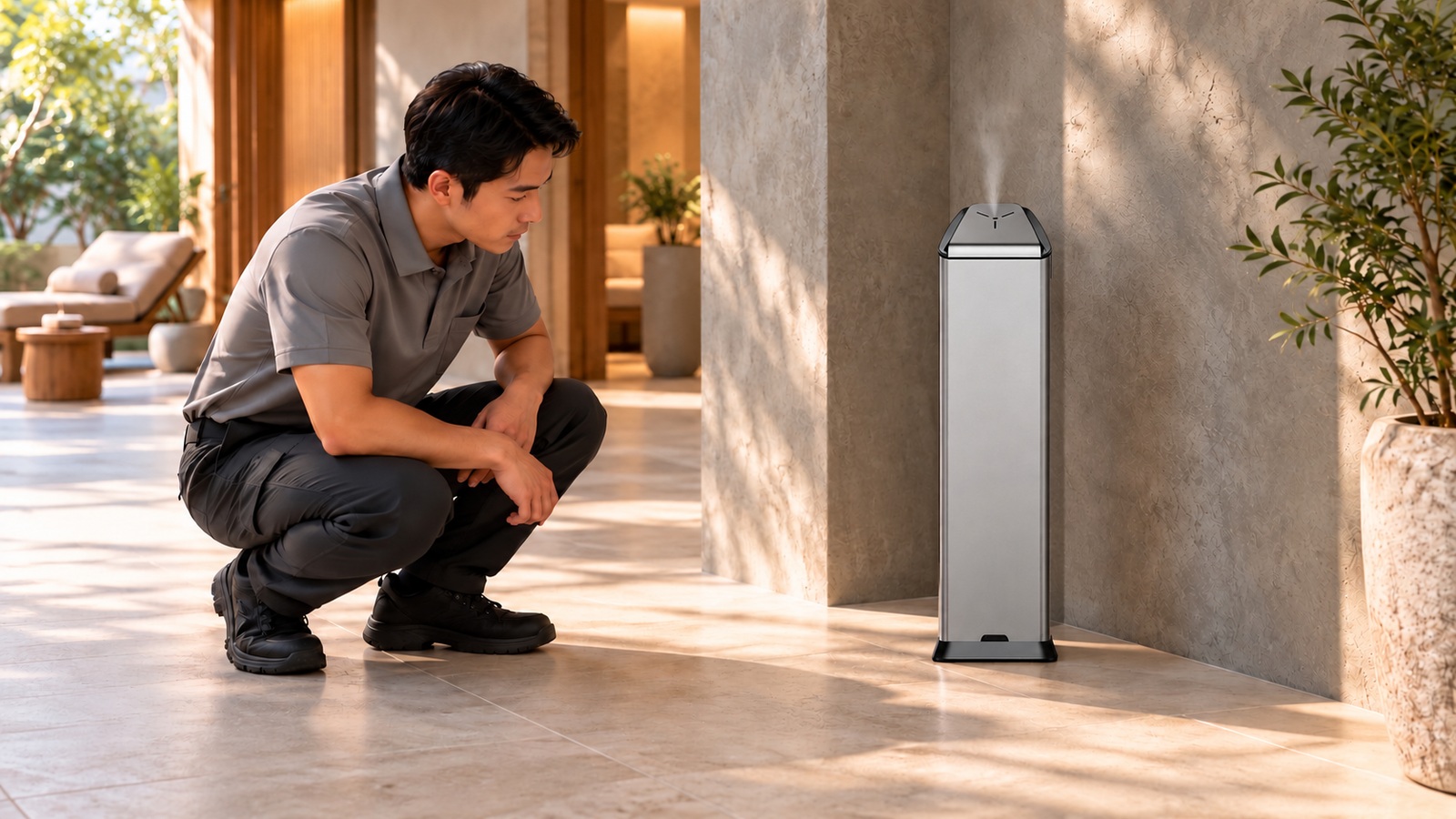
For M62, plan a floor position where the full base is supported on a suitable, level surface. Avoid letting part of the foot extend across a step, threshold, or change in floor height.
Do not use loose wedges or stacked objects to make an unsuitable position appear upright. If the surface is uneven or unstable, choose another approved location or resolve the underlying installation condition.
Keep the unit outside guest and staff circulation. Consider not just the quiet room, but the routes used by luggage, housekeeping trolleys, vacuum cleaners, and temporary event furniture.
Leave the outlet unobstructed and provide the clearances required by the supplied instructions. Do not bury the unit behind curtains or crowd it with decor to conceal its appearance. Route its power lead without crossing a walking path or creating tension that could pull the housing.
Good scent diffuser placement balances a usable fragrance position with stable support and practical service access.

An operating position and a transport condition are different things. Stopping a device does not automatically prepare it to be carried, laid flat, or packed.
Before relocation, stop operation, disconnect the power supply safely, and follow the current model instructions for the bottle, remaining oil, and liquid path. Do not assume that removing a bottle eliminates every trace of residual liquid.
For M62, use DANQ’s handling instructions to prepare the unit before packing or moving it to another site. Confirm any details that are unclear rather than improvising a drain or cleaning procedure.
Protect the housing and approved base during movement. At the destination, recheck the support, orientation, outlet clearance, and cable route before restarting. A packing arrow or an upright carton alone does not verify that the equipment inside was correctly prepared.
Stop using the device and disconnect power if it is safe to do so. Keep people clear of any spill and follow the fragrance supplier’s handling information.
Place the unit in its approved orientation and check accessible surfaces for leakage or damage. Do not switch it on simply to see whether fragrance still comes out. A successful startup does not establish that no liquid entered an unintended area.
If internal leakage is suspected, ask DANQ or an authorized service person how to inspect and recover the unit. Avoid opening electrical or pump assemblies outside the permitted user-maintenance instructions.
There is no universal “wait a few hours and restart” rule. The appropriate next step depends on what happened and the condition of the equipment.
Imagine a hotel that places M62 beside a lounge wall, clear of the guest route. During a furniture change, a team member considers laying it sideways on a trolley to make space.
The better response is to pause the move, follow the device’s relocation procedure, and identify a prepared floor position before restarting. The team also agrees who may move the equipment and records the approved location with a photo.
This is a hypothetical operating example, not a reported DANQ customer incident. Its value is organizational: a clear placement record helps prevent a carefully installed diffuser from being treated as ordinary furniture during the next room change.
Use this compact checklist when installing or returning a unit to service:
Approved position: The body matches the model’s specified operating orientation.
Stable support: The complete base rests on a suitable surface without improvised supports.
Clear surroundings: The outlet, service access, walking route, and cable path are appropriate.
Liquid condition: Bottle and accessible connections are prepared according to the supplied instructions, with no visible leak.
Assigned responsibility: Staff know the approved location, moving procedure, and contact for abnormal conditions.
Send DANQ a photo of your proposed M62 location for an initial placement discussion. Include the floor surface, nearby furniture, power connection, and normal walking route.
Not simply because it is off. Oil can still move inside. Follow the model’s relocation and storage instructions before changing its orientation.
A lower fill level does not establish spill-proof performance. The permitted orientation comes from the device instructions, not an estimate of how much oil remains.
Do not tilt or invert M62 during use. Review its approved location and the room’s airflow instead, and ask DANQ about appropriate placement for the space.
No. A protective feature, where fitted, does not authorize use outside the specified installation. Do not assume M62 includes such a feature without confirmation.
Correct scent diffuser orientation protects the intended liquid arrangement, while good placement provides support, outlet clearance, and safe access. Treat relocation as a planned task rather than a casual adjustment.
DANQ has developed and manufactured scent equipment since 2011 and supports OEM/ODM projects. Review the M62 product information, then share your venue layout, proposed floor position, and service arrangements.
Contact DANQ for M62 sample options, placement advice, and a project quotation. Confirm the installation and handling requirements before putting the equipment into regular use.

produttore professionista, da 2009.
diffondendo il profumo dell'amore in tutto il mondo.


Guangzhou DANQ Environmental Technology Co.,LTD